
 2 years ago
375
2 years ago
375 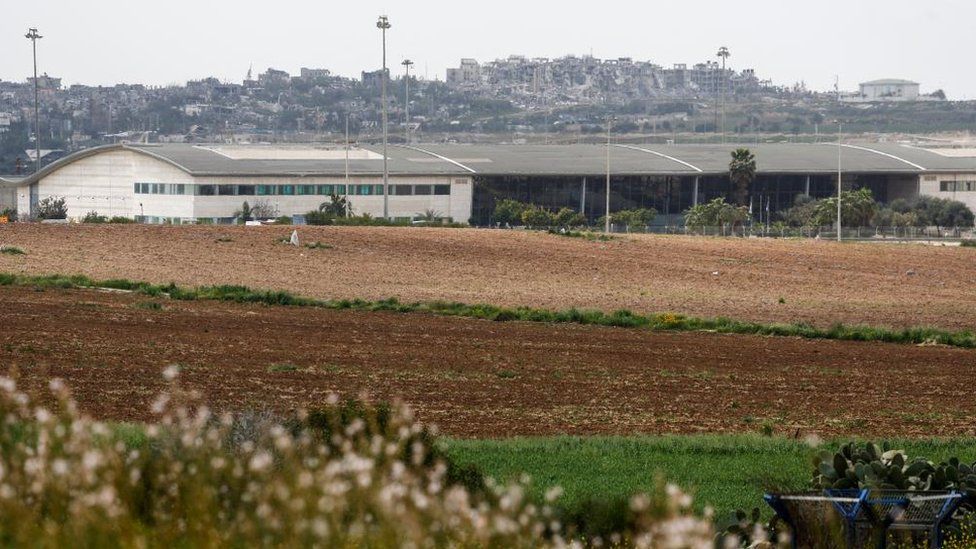 Image source, Reuters
Erez crossing has been closed since the outbreak of war
By Jemma Crew & Tom Spender
BBC News
Israel says it will open a crossing to northern Gaza, where starvation is most acute, and will also open its deep water port a short distance north of Gaza - but has not yet detailed how these routes will operate.
It follows the Israeli military's killing of seven aid workers on Monday, which prompted the US to tell Israel to prevent civilian harm and humanitarian suffering if it wanted to maintain US support.
The attack on aid workers had intensified fears of famine. World Central Kitchen (WCK) paused its operations in Gaza after its staff were killed on Monday. Four days later, no aid trucks had entered northern Gaza, residents told the BBC.
Aid agencies and foreign officials have long urged Israel to allow Ashdod to be used and to open more crossings, saying this could dramatically alleviate hunger.
More aid from Jordan would also be allowed to enter via the Kerem Shalom Crossing in southern Gaza, Israel said.
"I think it's a turning point," Jan Egeland from the Norwegian Refugee Council told the BBC.
"I think now the aid will flow freely, and I think there will be a protection scheme for civilians, including aid workers, that will work. Biden has now told Netanyahu to open up and now they have finally relented."
What are Ashdod port and Erez crossing, how will they operate?
Ashdod port, 32km (20 miles) north of Gaza, is one of Israel's three main cargo ports and can handle more than 1.5 million containers a year.
Until now, Israel has restricted its use for the delivery of aid. In February, the head of the UNRWA, the UN agency for Palestinians, said Israel was blocking a Turkish shipment containing a month's supply of food for a million Palestinians there.
The Erez crossing in between Israel and northern Gaza is the closest to Ashdod. Before the war, it was the only crossing point for people between Israel and Gaza.
It was used by Palestinians with permits to work in Israel, those who were approved to travel in exceptional humanitarian cases and some students and sportspeople. It was also used by staff from international aid organisations. It was attacked by Hamas on 7 October and has been closed since then.
However, so far, no details have been given of timings, quantities or the types of aid that will be permitted to enter Gaza, nor of how it will be distributed. As conditions have deteriorated, the delivery of aid has been accompanied by deadly violence.
There have been regular reports of shooting at Palestinians gathering to receive the little aid that has arrived in northern Gaza. The Hamas-run ministry of health in Gaza and local Palestinians have accused Israeli forces of firing on desperate people.
Israel has denied involvement, saying Palestinians have died in crushes, been run over by trucks and been shot by armed Palestinians, and that when Israeli troops have opened fire, it has been at people they have deemed "suspects".
Blame game over food shortages
The UN says children in northern Gaza are starving to death and famine is looming. The quickest, most effective way to get aid into the territory is overland - but the entry of trucks via two crossings in southern Gaza has so far not met the need for food.
Humanitarian agencies, Israel's allies and other countries have accused Israel of not doing enough to ensure that food gets to those who need it. Some have accused Israel of using starvation as a weapon of war.
All aid for Gaza is subject to strict Israeli security checks aimed at preventing anything that could be used by Hamas from entering. But aid groups say these are complex and arbitrary, causing major delays.
Israel has denied impeding the entry of aid to Gaza and accuses aid organisations of failing to distribute it.
Cogat, the Israeli body that co-ordinates humanitarian aid to Gaza, said on 1 April that an average of 140 trucks a day carrying food entered Gaza. It said this was more than the 70 trucks carrying food specifically that entered Gaza before the war (500 trucks in total entered Gaza each day before the war).
But military operations and the breakdown of social order have severely hampered aid distribution, while Gaza's food production has also been reduced to almost nothing, with farms, bakeries and factories destroyed or inaccessible.
Israel has also banned the UN's Palestinian refugee agency, UNRWA, from delivering aid to northern Gaza over allegations it made that some UNRWA staff took part in the 7 October Hamas attack that sparked the current war. Cogat said Israel would work with organisations that "are not involved in terror".
German Foreign Minister Annalena Baerbock said Israel had "no more excuses" to delay aid getting into Gaza after Israel agreed to open new routes.
"We expect the Israeli government to implement its announcements quickly," she said.
Image source, Reuters
Image caption,Palestinians carry bags of flour from an aid truck in Gaza City
As not enough food has been reaching people via land, countries have been trying alternative routes via the skies and sea - but these too have been beset by problems.
Air drops
The US, Jordan, Egypt, France, the Netherlands and Belgium are among the countries to have dropped aid into Gaza, but aid groups say the technique is a last resort that can't meet the need.
At least 20 Palestinians are reported to have been killed during air drops - five when a parachute on an aid package failed to open and the crate fell on people waiting below, and the others when aid packages fell in the sea and desperate people drowned while trying to retrieve them.
In late February, four tonnes of medicine, fuel and food for patients and staff at Tal al-Hawa hospital in Gaza city were dropped. The aid was UK-funded and air dropped by Jordanian Air Force.
The first aid drop by the US on 3 March, carried out jointly with Jordan, contained enough food for more than 38,000 meals. On 2 April, US Central Command, or Centcom, said it had dropped more than 50,000 meal equivalents into northern Gaza, "allowing for civilian access to the critical aid".
Maritime routes
Of the two schemes to get food and other aid into Gaza by sea, only one has begun operation and it has now been paused after the Israeli military attacked WCK, the aid agency that was unloading and distributing the aid from a jetty it had constructed.
Last month, the first vessel to reach Gaza under the scheme arrived from Cyprus - the nearest EU country to Gaza - towing a barge carrying about 200 tonnes of food provided by WCK.
By late March, WCK boss José Andrés said that 67 WCK kitchens were operating in Gaza, feeding 350,000 people a day.
Meanwhile, a separate US military plan is in train, with a US navy ship on its way carrying materials to build a floating dock and pier, to enable supplies on far larger cargo ships to get ashore.
Image source, EPA
Image caption,Ashdod is a modern container port 20 miles north of Gaza
According to the US defence department, it will mean two million meals a day could enter Gaza, much more than is currently possible through the Rafah border crossing with Egypt or through air drops.
But the pier was not expected to be ready for months.
Entry of trucks over land
The first convoy into Gaza, 20 trucks carrying aid from the UN and Egyptian Red Crescent, entered on 21 October via the Rafah crossing on the border with Egypt - two weeks after Hamas attacked southern Israel, sparking the current war.
In November, the World Food Programme (WFP) said just 10% of needed food supplies had entered Gaza since the start of the war.
Some 750 tonnes of food aid arrived on 20 December last year, using a land route from Jordan across Israel and through the Kerem Shalom crossing to southern Gaza for the first time. The WFP convoy was made up of 46 trucks. A second delivery of 315 tonnes was made in January 2024.
In total during January, the WFP said it had managed to get just four convoys into Gaza - about 35 truckloads of food, enough for almost 130,000 people.
Last month, the UN said a new land route had been used to deliver food to northern Gaza for the first time in three weeks. The Israeli military said six WFP lorries crossed via a gate in the Gaza border fence. The delivery was "part of a pilot to prevent Hamas from taking over the aid", it added.
It was the first UN delivery to this part of Gaza in three weeks, after the WFP paused deliveries "until conditions are in place that allow for safe distributions".
In the bloodiest incident, more than 100 people were reported killed on 29 February when a convoy arrived at al-Rashid Street in Gaza City. Palestinians accused Israel of shooting people dead at the convoy. Israel initially said most were killed by being trampled or run over by the convoy. It later said troops had fired at people who it deemed "suspects" posing a threat.



















 Bengali (Bangladesh) ·
  English (United States) ·